Dispelling myths from the soil of Nakiyadeniya
The primary argument levelled against oil palm in Sri Lanka has been the persistent claim that its root system acts as an insatiable hydrological vacuum, draining nearby wells and desiccating community water tables.
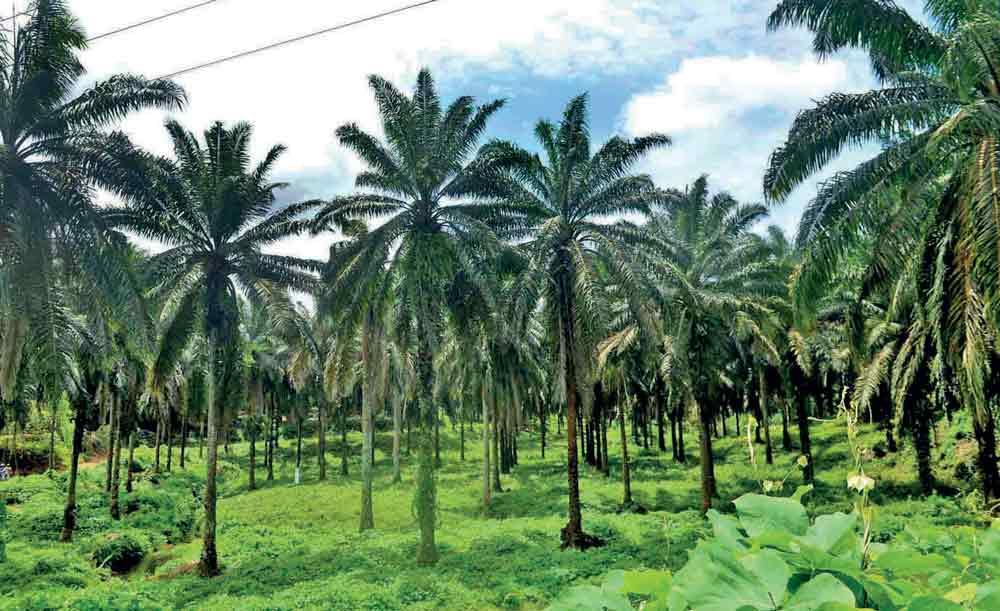
Winding through the lush southern foothills of the Galle district towards the Nakiyadeniya estate, the visual reality on the ground immediately shatters the apocalyptic narrative that has dominated Sri Lanka’s plantation discourse over the past decade. For years, environmental lobbyists, political commentators, and populist policymakers have painted oil palm cultivation as an ecological catastrophe, alleging that the crop creates barren green deserts, drains subterranean aquifers, and sterilises native biodiversity. Yet, walking beneath the mature canopy of Watawala Plantations PLC’s flagship Nakiyadeniya estate reveals a starkly different, scientifically grounded reality.
Far from being a parched wasteland, the estate floor is carpeted with dense understorey vegetation, nitrogen-fixing leguminous cover crops, and rich organic mulches formed by systematically stacked pruned fronds. Clear, perennial streams flow uninterrupted across the plantation landscape, fed by the region’s torrential monsoon rainfall and shielded by strictly maintained, chemical-free riparian buffer zones. Most notably, Nakiyadeniya stands as the operational core of the first and only oil palm enterprise in South Asia to secure certification from the Roundtable on Sustainable Palm Oil (RSPO)—the globally recognised benchmark for environmental, social, and agronomic compliance.
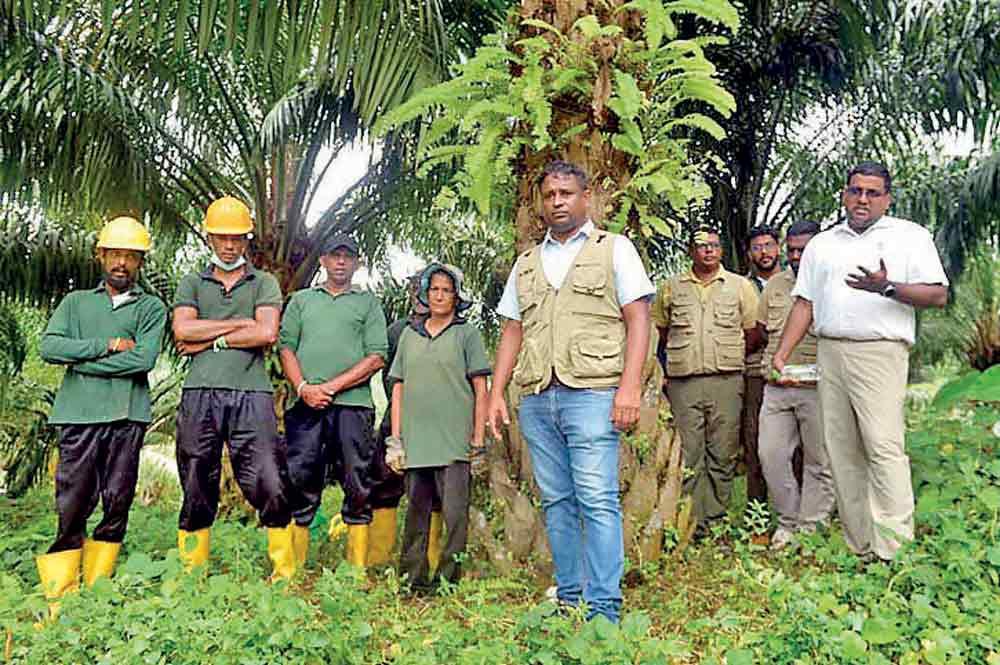
As Sri Lanka navigates a fragile post-crisis economic recovery, burdened by structural foreign exchange constraints and unsustainable import bills, the tragedy of its demonised oil palm sector becomes starkly apparent. The blanket ban on oil palm cultivation imposed by executive fiat in April 2021, coupled with an unscientific mandate forcing regional plantation companies to uproot 10 percent of their mature acreage annually, mirrors the catastrophic 2021 agrochemical prohibition as one of the most economically destructive policy blunders in modern Sri Lankan history. An extensive on-site investigation of Nakiyadeniya proves that responsible oil palm cultivation is not merely ecologically sustainable, but an indispensable macroeconomic catalyst capable of saving tens of billions of rupees in foreign exchange while unlocking unprecedented value in agricultural exports.
Deconstructing the hydrological fallacy
The primary argument levelled against oil palm in Sri Lanka has been the persistent claim that its root system acts as an insatiable hydrological vacuum, draining nearby wells and desiccating community water tables. During an in-depth technical briefing and field tour organised by the Palm Oil Industry Association of Sri Lanka (POIA), agricultural scientists and estate executives laid out empirical data to challenge this misconception.
Plantation hydrologists and agronomists explain that oil palm features an extensive, fibrous, and adventitious root system that concentrates predominantly within the upper 30 to 50 centimetres of the soil profile. Unlike deep taproot trees that penetrate deep aquifers, this dense, fibrous network functions essentially like an underground biological sponge, intercepting rapid surface runoff, enhancing rainwater infiltration, and recharging local subsoil water tables.
Climatological and physiological metrics further dismantle the water-depletion narrative. In the Udugama and Nakiyadeniya plantation belt, annual rainfall routinely ranges between 4,500 and 5,500 millimetres, occasionally exceeding 8,000 millimetres during intense monsoon cycles. An adult oil palm tree requires approximately 1,100 to 1,300 millimetres of water annually to maintain optimal metabolic activity—a mere fraction of the ambient precipitation received in the southern wet zone.
“There is a pervasive myth that cultivating oil palm turns fertile land into a desert,” said Yajith de Silva, Chief Operating Officer of the Palm Oil Industry Association. “People often talk about water consumption on a per-tree basis without understanding planting density or regional hydrology. A single oil palm tree might consume around 240 litres of water a day, but with a standard planting density of 140 palms per hectare, the total water requirement per hectare is around 33,000 litres daily. In comparison, a hectare of commercial tea contains 10,000 to 12,000 bushes and consumes up to 60,000 litres of water daily, while rubber consumes over 31,000 litres. In a region receiving 5,000 to 8,000 millimetres of annual rain, we receive nearly eight times more water than the crop could ever consume.”
De Silva emphasised that in global powerhouses like Malaysia and Indonesia, millions of hectares of oil palm thrive under annual rainfall levels of 2,500 millimetres without inducing environmental desertification. “If oil palm inevitably caused desertification, Malaysia and Indonesia would be vast arid deserts by now,” he observed. “Instead, Malaysia supplies fresh water directly to Singapore. Environmental assessments must be grounded in empirical data rather than fabricated alarmism.”
The tangible proof of hydrological stability is evident throughout the surrounding villages. Across the Nakiyadeniya estate, local communities and worker settlements continue to draw their daily domestic drinking water directly from natural springs, perennial streams, and gravity-fed pipe-borne networks that originate inside the oil palm fields.
“When we look at our community engagement across Nakiyadeniya, the water argument completely falls apart on the ground,” stated Prasanna Premachandra, Deputy General Manager – Operations at Watawala Plantations PLC. “Every single worker household on this estate, as well as several adjacent village communities, receives their daily drinking and domestic water from pipe-borne gravity networks tapped directly inside our oil palm fields. If these plantations were drying up the water table, our own workers and neighbours would have been the first to suffer. Instead, our water sources remain perennial, clean, and abundant year-round.”
Taking water stewardship a step further, the plantation management has successfully reconstructed and maintained the Carbeal Lake within the estate. This artificial water body serves as an active catchment reservoir, maintaining local microclimatic stability and supporting freshwater biodiversity, with regular releases of fish fingerlings to foster a thriving aquatic ecosystem.
Lowland biodiversity and the sanctuary of hidden wildlife
Far from sterilising the landscape, responsible plantation management at Nakiyadeniya has created a thriving habitat for native fauna and flora. Independent aquatic surveys conducted across the freshwater stream networks of Nakiyadeniya and the adjacent Homadola estate provided critical data that contributed to the formal scientific discovery and cataloguing of Schistura scripta, commonly known as the Sri Lanka Mountain Loach.
This rare, endemic freshwater fish species, recorded within the tributaries of the Gin River basin, is exceptionally sensitive to water pollution, siltation, and agrochemical runoff. Its continued presence and active breeding within streams that weave through active oil palm blocks offer undeniable biological proof of effective soil conservation and riparian habitat preservation.
“Environmental concerns surrounding any plantation crop must be taken seriously,” said Yajith de Silva. “However, conclusions should be based on scientific evidence, site-specific conditions, and actual land-management practices. The understorey vegetation, compatible crops, functioning water resources, and biodiversity observed in the Southern Region demonstrate why broad assumptions cannot replace proper environmental assessment.”
The ecological richness of the estate extends well beyond aquatic life, anchoring itself deeply into the broader Kanneliya-Dediyagala-Nakiyadeniya (KDN) lowland rainforest complex. This biosphere reserve network provides a sanctuary for a remarkable array of endemic mammals and apex predators. Environmental impact assessments and internal wildlife monitoring indicate that the Nakiyadeniya estate’s carefully preserved buffer zones and secondary forest patches are home to the Sri Lankan leopard (Panthera pardus kotiya), the fishing cat (Prionailurus viverrinus), and the elusive rusty-spotted cat (Prionailurus rubiginosus).
To protect these threatened felines from poaching, accidental trapping, and human-wildlife conflict, plantation officials intentionally keep specific nesting locations and roaming corridors confidential from outsiders, allowing these predators to hunt and traverse undisturbed through the plantation’s ecological corridors.
The RSPO benchmark and zero-waste circular manufacturing
What truly sets Nakiyadeniya apart across the regional agricultural landscape is its parent company’s adherence to the world’s most stringent environmental accreditation. Watawala Plantations PLC achieved full RSPO certification in 2020, establishing Nakiyadeniya as the first and only oil palm plantation in South Asia to earn this global recognition.
Unlike industrial operations in parts of Southeast Asia that expanded through the deforestation of pristine tropical rainforests, oil palm in Sri Lanka is cultivated exclusively on pre-existing, commercially leased state plantation lands previously occupied by unproductive rubber or degraded tea. Not a single hectare of virgin forest has ever been cleared for oil palm cultivation in the country.
“Achieving RSPO certification was a rigorous, eight-year journey for Watawala Plantations after we initiated the process in 2012,” explained Premachandra. “RSPO is not an ordinary certificate; it enforces a strict zero-deforestation baseline, comprehensive protection of High Conservation Value areas, absolute bans on planting along waterways or steep slopes, and complete transparency across the supply chain. Independent international auditors inspect our fields annually, checking everything from soil nutrient management and chemical storage to worker welfare, occupational safety, and community relations. Being the only certified plantation in South Asia proves that Sri Lanka can manage this crop at the highest tier of global sustainability.”
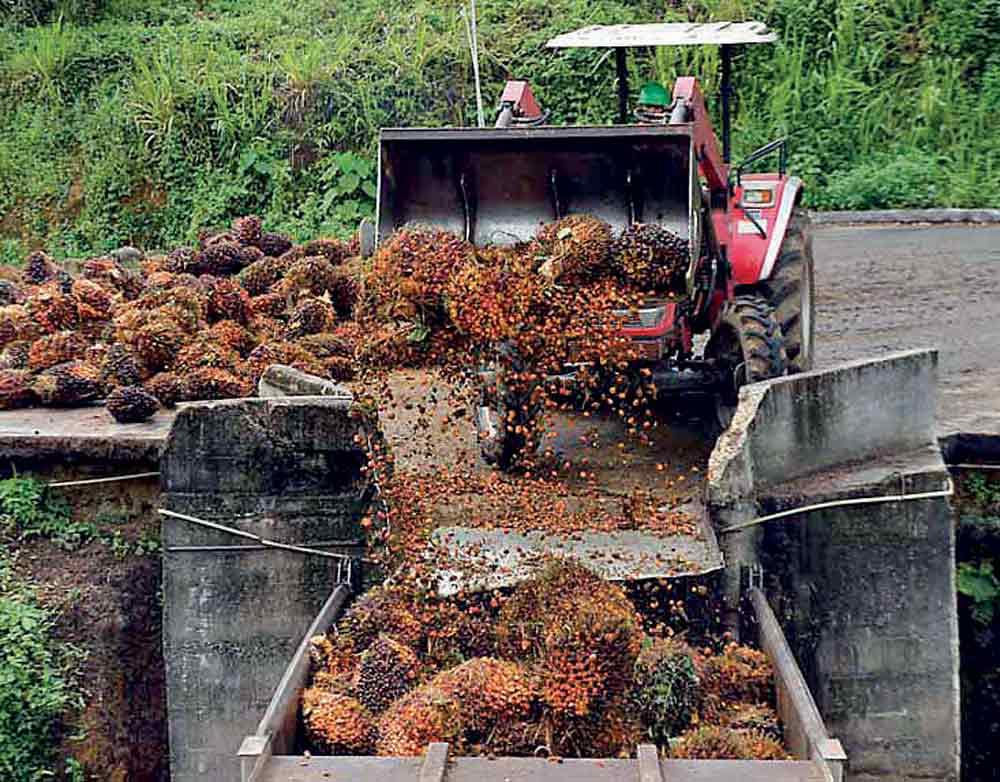
At the heart of Nakiyadeniya’s sustainable footprint is its modern, fully mechanised, closed-loop processing mill. Operating with an intake capacity of 225 metric tonnes of fresh fruit bunches per day, the facility processes harvested crops within 24 to 48 hours to extract premium crude palm oil. The entire extraction process operates on a strict zero-waste model.
Solid waste products generated during milling are entirely recycled. Empty fruit bunches are returned directly to the plantation fields as organic, moisture-retaining mulch, while shredded mesocarp fibres and palm kernel shells are channelled into the mill’s high-pressure biomass boilers. These boilers generate over 20 million kilowatt-hours of clean, renewable steam and electrical energy annually, making the processing factory completely energy self-sufficient. Furthermore, industrial palm oil mill effluent is routed through specialised anaerobic and aerobic biological treatment ponds, rendering the wastewater completely safe for agricultural fertigation under Central Environmental Authority guidelines.
The Ghana experiment and untapped industrial distillation
The ecological narrative is reinforced by the field experiences of Sri Lanka’s foremost plantation scientists. Professor Ashoka Nugawela, former Director of the Rubber Research Institute of Sri Lanka and a senior plantation consultant, shared striking insights during the field tour regarding crop diversification and the untapped economic potential of mature oil palm.
Recalling an international consultancy mission to Ghana funded by the Japan International Cooperation Agency alongside Dr. Jerry Jayawardena, former Director General of the Department of Agriculture, Professor Nugawela detailed how West African nations maximise returns from oil palm stands that have reached the end of their 25-to-30-year economic lifespan.
“In Ghana, while working on rubber development, we observed extensive oil palm estates reaching the end of their economic lifecycle,” Professor Nugawela recounted. “Instead of simply felling and burning the trees, they uproot the palms with the root ball intact. They strip the fronds, expose the growing apical bud, or the shoot, and make precise daily incisions, exactly the way our traditional tappers slice a coconut inflorescence. From a single felled tree, they harvest six to ten bottles of sweet sap, or palm toddy, every single day for up to six continuous months.”
Upon returning to Sri Lanka, Professor Nugawela replicated the experiment at Nakiyadeniya. “We felled a mature palm at Nakiyadeniya and conducted the exact same tapping process,” he explained. “We extracted high-grade sap and sent samples directly to the state distilleries corporation to test its suitability for commercial distillation. The laboratory confirmed that the sap possessed exceptional fermentable sugar levels, ideally suited for industrial alcohol and high-value spirits. This demonstrates that even at the point of clearing, mature oil palm holds massive, unexploited commercial and economic potential.”
Professor Nugawela pointed out that Sri Lanka currently has an estimated 2,500 to 3,000 hectares of over-aged oil palm trees across regional plantation companies, including Watawala Plantations, that require systematic uprooting and replanting. “An oil palm reaches its peak productivity between eight and ten years of age and sustains high yields until around 25 years,” he said. “Holding mature palms past their economic lifespan leads to declining yields and makes harvesting increasingly difficult. Preventing plantation companies from replanting these lands only harms the national economy and diminishes land productivity.”
Agronomic imperatives: the wet-zone rubber crisis
The urgent necessity for oil palm cultivation is also intimately tied to the structural crisis currently facing Sri Lanka’s traditional rubber industry. Professor Nugawela provided a candid assessment of the severe agronomic challenges plaguing rubber estates across the low-country wet zone.
Over recent years, rubber plantations across Kalutara, Galle, Ratnapura, and Kegalle have been devastated by the aggressive spread of Pestalotiopsis, a fungal leaf fall disease that defoliates rubber canopies and causes tree mortality. Combined with changing climatic patterns and erratic, heavy rainfall that frequently disrupts rubber tapping schedules, rubber production in the wet zone has collapsed to economically unsustainable levels.
“In the past, a rubber estate could achieve around 300 tapping days a year, generating average yields of 1,200 kilograms per hectare,” Professor Nugawela explained. “Today, due to persistent rainfall interference and the devastating impact of Pestalotiopsis leaf disease, estates struggle to complete even 140 to 150 tapping days annually. Yields in many low-country wet-zone estates have plummeted below 500 kilograms per hectare, with some areas dropping to just 300 kilograms. At those levels, the cost of production far exceeds the market price, resulting in massive operational losses.”
Professor Nugawela emphasised that regional plantation companies cannot continue absorbing heavy losses on unproductive land while carrying large resident labour forces. “Estate companies employ thousands of resident workers who rely on regular daily wages,” he said. “When rubber fails completely due to disease and climate shifts, companies must have the flexibility to diversify into economically viable alternative crops like oil palm. Oil palm harvesting is far less vulnerable to rainfall disruptions, provides steady year-round revenue, and offers plantation workers the highest daily income-earning potential in the entire agricultural sector.”
Macroeconomic dividends: forex conservation and coconut export synergies
Beyond the environmental debate lies a stark macroeconomic dilemma. Sri Lanka consumes approximately 220,000 to 240,000 metric tonnes of edible oils annually across retail domestic kitchens, industrial bakeries, confectioneries, biscuit manufacturers, and pharmaceutical operations. However, domestic production across all vegetable oil categories meets barely 20 percent of this national demand.
To satisfy the remaining 80 percent deficit, Sri Lanka imports over 180,000 metric tonnes of crude palm oil and specialty vegetable fats each year, draining between Rs. 45 billion and Rs. 60 billion in scarce foreign exchange reserves. During the balance-of-payments crisis in 2022, the inability to finance edible oil imports triggered severe supply shortages, drove retail prices to unprecedented highs, and exposed commercial food manufacturers to adulterated, unrefined oils.
The fundamental economic justification for oil palm lies in its unmatched agricultural productivity. Oil palm is biologically the most efficient oil-bearing crop in the world. A well-managed hectare of oil palm at Nakiyadeniya yields between 3.5 and 4.5 metric tonnes of crude palm oil annually, with long-term agronomic potential reaching 7 to 8 metric tonnes under optimal management. In sharp contrast, coconut produces approximately 0.7 to 0.8 metric tonnes of oil per hectare per year.
“To meet Sri Lanka’s annual edible oil deficit exclusively through coconut oil, the country would have to clear and plant an additional 250,000 to 300,000 hectares of land with coconut palms—a spatial and environmental impossibility on an island with severe land constraints,” De Silva pointed out. “In stark contrast, the entire national edible oil import bill could be completely wiped out by cultivating just 50,000 hectares of sustainably managed oil palm on existing, unproductive plantation lands. That represents less than three percent of the country’s total agricultural land.”
A widespread misconception within domestic political discourse is that promoting palm oil undermines the traditional coconut industry. Agricultural economists and plantation leaders stress that oil palm and coconut are deeply complementary crops that serve entirely different market segments.
Coconut is an extraordinarily valuable, high-margin export crop. International markets offer lucrative premiums for value-added coconut products, including virgin coconut oil, desiccated coconut, coconut milk powder, liquid coconut cream, and activated carbon derived from coconut shells. When Sri Lanka forces its domestic food industry and household consumers to rely on crushing fresh coconuts for local cooking oil, it diverts billions of fresh nuts away from high-value export manufacturing.
By scaling domestic oil palm cultivation to satisfy local culinary frying, commercial baking, and industrial confectionery fat requirements, Sri Lanka can liberate millions of fresh coconuts for export processing. Plantation economists calculate that replacing domestic coconut oil consumption with home-grown palm oil could immediately unlock an estimated Rs. 300 billion to Rs. 450 billion in export revenue, propelling the national coconut industry towards the government’s targeted annual export earnings milestones.
Overcoming policy paralysis with scientific pragmatism
The ongoing regulatory prohibition on oil palm reflects a broader, troubling pattern in Sri Lanka’s public policy formulation: the subjugation of scientific evidence, agricultural economics, and technical assessments to populist disinformation campaigns.
Following the controversial 2021 ban, the Ministry of Plantation Industries appointed a multidisciplinary 13-member expert committee—comprising leading agricultural scientists, university professors, soil chemists, and plantation economists—to thoroughly re-evaluate oil palm cultivation. The expert committee reviewed previous environmental claims, analysed comprehensive field data, and submitted an official report formally recommending that the government lift the blanket ban and permit regulated, zoned commercial oil palm cultivation under strict environmental safeguards.
Despite these unequivocal scientific recommendations, the revocation of the gazette remains stalled within bureaucratic and political corridors. Regional plantation companies that invested billions of rupees in modern infrastructure, automated mills, and certified field nurseries were forced to destroy hundreds of thousands of commercial seedlings under state mandates, halting vital capital investment and undermining agricultural employment.
The living conditions across the Nakiyadeniya estate provide an undeniable, real-world refutation of the myths that have paralysed the sector. Sustainable oil palm cultivation is not an environmental hazard; it is a meticulously monitored, scientifically managed, and economically transformative crop. The path forward demands an immediate, evidence-based policy correction. The government must revoke the arbitrary 2021 prohibition gazette, abandon the unscientific uprooting directive, and establish a transparent regulatory framework that permits licensed commercial oil palm cultivation under RSPO-aligned standards.
Sri Lanka cannot afford to let unfounded dogmas dictate national agricultural policy while tens of billions of rupees are drained annually to import commodities that can be sustainably, cleanly, and profitably produced on its own soil. Nakiyadeniya offers the living, flourishing proof; it is time for national policy to catch up with the science.