Oil palm policy must follow evidence, not assumptions: POIA
Yajith de Silva, Chief Operating Officer of the Palm Oil Industry Association of Sri Lanka (POIA), is accustomed to confronting one of the most deeply entrenched perceptions surrounding oil palm cultivation in Sri Lanka: that the crop is inherently harmful to the environment.
His message following recent observations in the Southern Region is straightforward – environmental policy should be based on scientific evidence and conditions on the ground, rather than assumptions imported from very different plantation environments elsewhere.
“Environmental concerns surrounding any plantation crop must be taken seriously. However, conclusions should be based on scientific evidence, site-specific conditions and actual land-management practices,” de Silva said.
The observations from established oil palm plantations in the Galle area offer an opportunity to reopen a debate that has often been dominated by competing claims rather than comprehensive evidence.
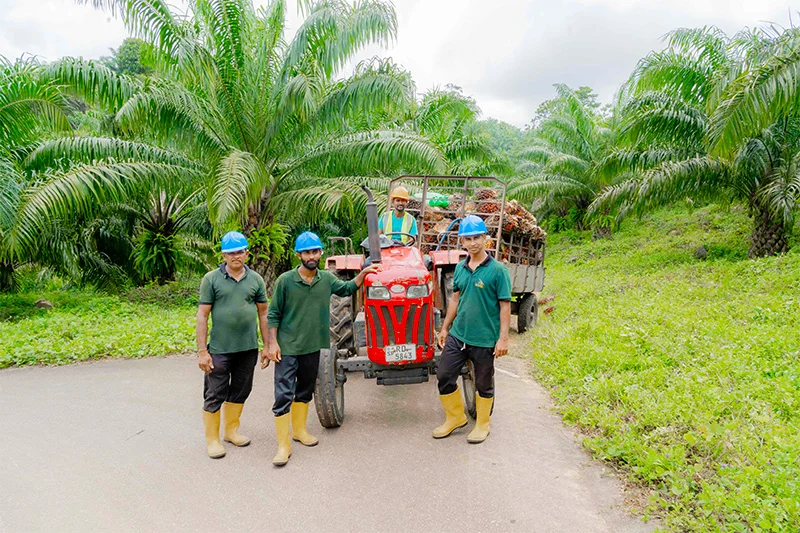
Contrary to the popular image of oil palm plantations as landscapes of bare and exhausted soil, substantial understorey vegetation was visible beneath the palms. Ground cover can reduce soil erosion and surface runoff, retain moisture and contribute organic matter to the soil.
Pruned palm fronds are also strategically stacked on the plantation floor, allowing biomass to decompose and return nutrients to the soil. In suitable locations, compatible crops and other vegetation can coexist with oil palm, depending on factors such as the age of the palms, available sunlight, soil conditions and terrain.
Water resources and environmental monitoring
Perhaps more significant for the public debate is the question of water.
Water resources were observed within and around cultivated areas, while communities continue to depend on water sources in the plantation landscape. This does not, by itself, prove that oil palm can never affect local water availability. Rather, it demonstrates why claims that the crop automatically dries up wells and streams require careful scientific qualification.
The appropriate policy response, therefore, should be monitoring and regulation rather than sweeping assumptions.
Protection of waterways, riparian buffers and drainage systems, responsible fertiliser and agrochemical use, soil conservation and regular monitoring of water availability and quality should form part of any credible oil palm policy.
Biodiversity within plantation landscapes
There is also evidence of biodiversity surviving within these plantation landscapes. Earlier freshwater research at the Nakiyadeniya and Homadola estates contributed to the scientific identification of Schistura scripta, the Sri Lanka Mountain Loach, an endemic freshwater fish found in the Gin River basin.
Its presence does not make oil palm cultivation environmentally benign by definition. But it does illustrate the importance of protecting streams, riparian habitats and ecological connectivity within agricultural landscapes.