Has oil palm industry hampered the natural rubber industry?
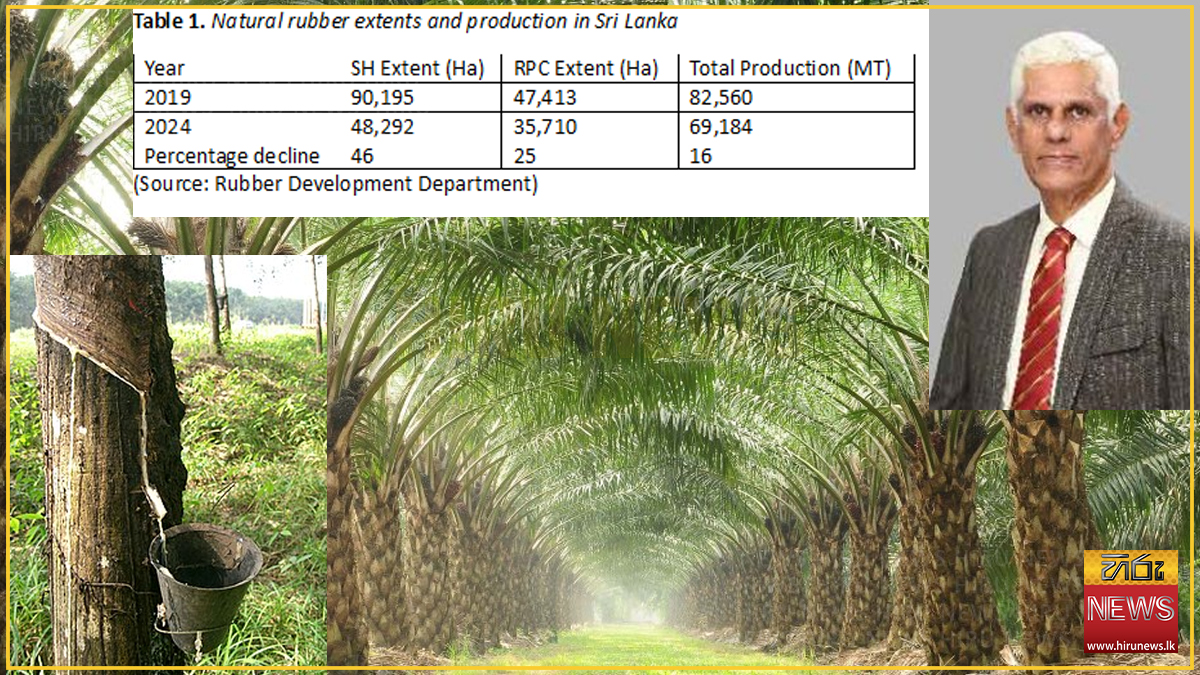
The Centre for Environmental Justice (CEJ) recently stated at a press conference that lifting the ban on oil palm cultivation could adversely affect Sri Lanka’s natural rubber industry. Indeed, the extent of natural rubber cultivation and overall production in the country has been declining rapidly.
However, Wayamba University of Sri Lanka Emeritus Professor and former Director of the Rubber Research Institute of Sri Lanka, Asoka Nugawela, questioned whether the downturn in the natural rubber industry can be directly attributed to oil palm cultivation.
From 2019 to 2024, the country's total rubber production has dropped by 16%. The extent under Small Holders (SH) has dropped by 46%, while the extent under Regional Plantation Companies (RPCs) has dropped by 29%.
The above data reveals that the decline in the Small Holder sector in the country has largely contributed to the drop in rubber production from 2019 to 2024. Further, the data show that total rubber production has declined by only 16% during this period, while the land extent has declined by 38%.
It appears that low-productivity land parcels with no significant economic gains to the grower have moved away from cultivating rubber. Also, the decline in rubber extents in the country since 2019 cannot be attributed to cultivating oil palm, since the cultivation of oil palm in the country was not permitted by law. Deterioration in the rubber industry in the country is thus mainly because of low financial gains due to low productivity caused by multiple reasons, stagnant prices, and escalating costs.
It is no brainer that the rubber industry in the country needs to be developed. It has huge potential to earn foreign exchange, create employment, and contribute to the economic development of the country. In order to drive investors into cultivating rubber, they need to be convinced that a package exists to obtain attractive returns on their investments.
The current climatic conditions in the traditional rubber growing areas, the incidence of Pestalotiopsis leaf disease, white root disease, and Tapping Panel Dryness are eroding profitability and interest of the investors in natural rubber. There exist alternative strategies to overcome these challenges faced by the rubber growers.
Any organization genuinely interested in the development of the country and the rubber industry should drive policymakers to implement strategies that would make rubber cultivation a worthwhile investment for growers.
The CEJ also seems not to be aware that 20,000 ha of oil palm cultivation in Sri Lanka is intended for local consumption rather than export.
This hectarage will allow the country to substitute about 80,000 MT of palm oil imports, thus saving foreign exchange up to US$100 million each year. To produce the same volume of vegetable oil from coconut, another 80,000 hectares of coconut would have to be newly cultivated, or production from existing coconut lands would have to be increased by a further 500 million nuts.
Responsible organizations should be more careful when information is disseminated to the public in order to prevent disruption of development projects in the country and avoid hampering economic growth.